



There’s a phrase we use often at SMB Value Investing Group: if the downside is survivable, the upside becomes investable. It sounds simple. But in practice, building a deal that genuinely protects capital not just on paper but through real-world stress requires a level of intentionality that most deal structures don’t deliver.
Independent sponsor transactions are unique in that there’s no blind pool of capital, no fund-level diversification smoothing out individual mistakes. Every deal stands on its own. Which means every deal has to be built to absorb volatility before it tries to generate returns. For accredited investors going through an independent sponsor investment process, this distinction matters enormously.
So what does thoughtful downside protection actually look like? At SMB Value Investing Group, we’ve found it comes down to two things working together: structure and fundamentals. Neither one alone is sufficient.
Why Structure Matters More Than Most People Realize
A lot of capital gets deployed into independent sponsor deals on the strength of a compelling growth story. And growth stories are great when they pan out. The problem is that in lower middle market SMB transactions, a lot can go sideways. Key employees leave. Customers consolidate. A seller’s relationships don’t transfer the way the model assumed. Integration takes twice as long.
In those moments, what saves capital isn’t the thesis. It’s the structure.
Seller Notes: More Than Just a Financing Tool
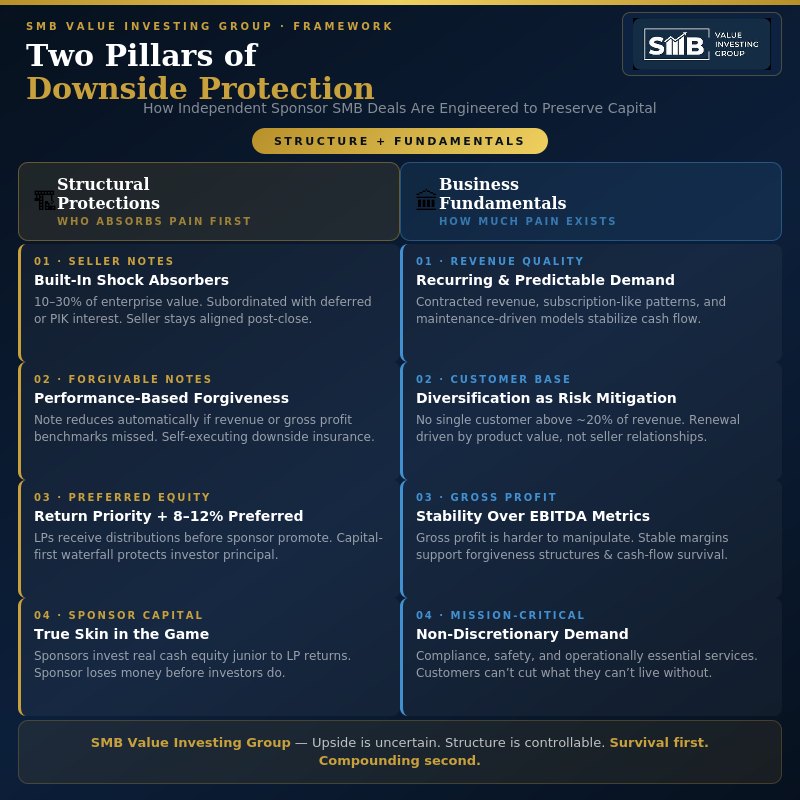
One of the most powerful structural protections in an independent sponsor deal is a well-designed seller note. These typically represent 10 to 30 percent of enterprise value, and when structured correctly, they do something important: they keep the seller economically tethered to the business after close.
A seller who carries a note has skin in the game. They want to see the business succeed because their payment depends on it. And when subordinated to senior debt with flexible repayment terms, deferred interest, PIK options, and maturities aligned with stabilization timelines, a seller note gives the business breathing room if performance stumbles early.
What makes this even more compelling is a structure we use frequently at SMB Value Investing Group: forgivable seller notes tied to revenue or gross profit performance. If the business underperforms against agreed benchmarks, a portion of the seller note is automatically written down. No litigation. No renegotiation. No awkward conversations. The purchase price adjusts mechanically in response to real performance.
This is, in our view, one of the most underutilized downside protection tools in the market. It transfers a meaningful portion of downside risk to the seller, the party with the most information about the business, while preserving equity capital for investors.
Preferred Equity and Liquidation Preferences
Structure also shapes how capital is recovered when things don’t go according to plan. Preferred equity with a meaningful return priority, typically 8 to 12 percent, combined with clear liquidation preferences ensures that investor capital comes first. Sponsors earn their carry only after LPs have been made whole.
This matters in independent sponsor deals because promote structures vary widely, and without explicit protections, a flat exit or partial realization can quietly favor the sponsor’s economics over investor capital. Properly designed waterfalls eliminate that ambiguity. They make the incentive alignment legible.
Sponsor Capital at Risk
Perhaps the most direct signal of alignment in assessing independent sponsor quality in SMB deals is whether the sponsor has meaningful personal capital invested in the same stack as LPs. Not deferred fees. Not rolled carry. Actual cash equity, junior to preferred returns, is exposed to the same downside.
When a sponsor loses money before investors do, the alignment isn’t just contractual; it’s visceral. That changes behavior at the operating level in ways that term sheets alone cannot.
Business Fundamentals: Structure Can’t Save a Weak Business
Good structure buys time. It creates flexibility. But if the underlying business is fundamentally fragile, even the best capital stack won’t preserve principal. Assessing independent sponsor quality in SMB deals always requires a hard look at what the business actually is, not what the model says it could become.
Revenue Predictability and Customer Diversification
At SMB Value Investing Group, we have a strong preference for businesses with recurring or highly predictable revenue. Contracted service models, maintenance and compliance-driven demand, and subscription-adjacent payment patterns—these characteristics stabilize cash flow and reduce the risk of a sudden, unexpected decline.
Customer concentration is one of the most common risks we see underweighted in SMB underwriting. A single customer representing 40 percent of revenue isn’t just a business risk; it’s an existential one. When that customer churns or renegotiates, the entire investment thesis can collapse overnight. We look for diversification that holds up even after the seller steps back, with renewal decisions that are driven by product value rather than personal relationships.
Gross Profit Over EBITDA
This one tends to surprise people. In downside scenarios, gross profit is often a more reliable signal than EBITDA. EBITDA can be engineered with expense timing, add-backs, and one-time adjustments. Gross profit is harder to massage, closer to the economics of what the business actually produces.
When gross profit is stable and well understood across customer segments and service lines, the business has genuine flexibility. Operating expenses can flex. The forgivable seller note structure we described earlier can be anchored to gross profit thresholds rather than more manipulable earnings metrics. And in a soft operating environment, the business can survive and adapt rather than spiral.
Mission-Critical Demand
Discretionary businesses suffer first in downturns and recover last. Businesses that are embedded into customer operations compliance services, safety-related products, and workflow-critical software don’t face the same existential demand risk. When evaluating any deal, we ask: would a customer cancel this during a budget cut, or is it operationally non-negotiable? The answer shapes how we underwrite the floor.
When Protection and Fundamentals Work Together
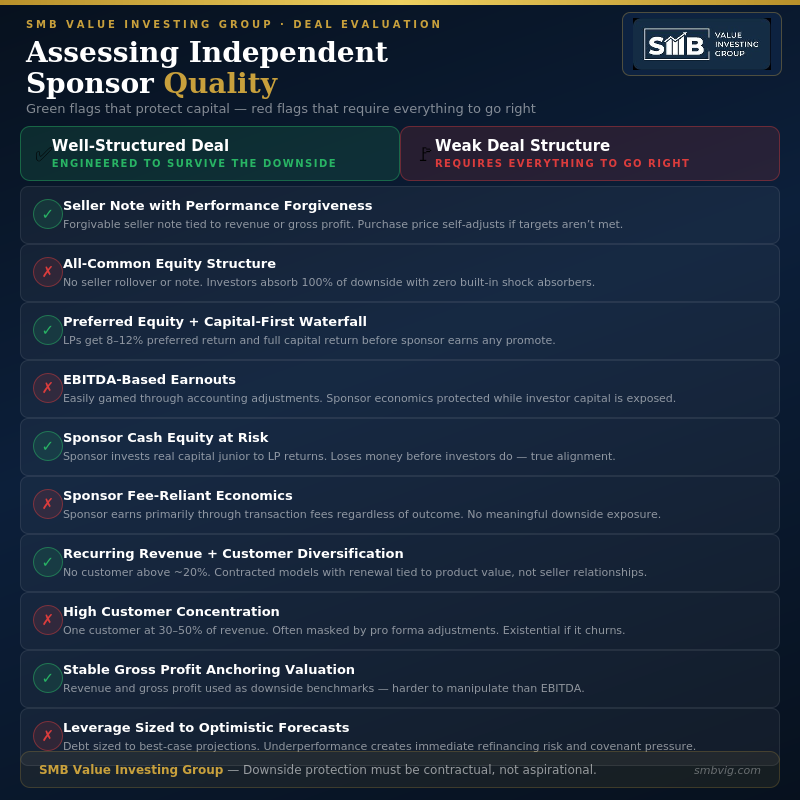
The most resilient independent sponsor deals we’ve seen combine all of these elements: predictable revenue, stable gross profit, a seller note with performance-based forgiveness, preferred equity with seniority, a clear liquidation waterfall, and a sponsor with meaningful capital at risk.
In those structures, underperformance doesn’t have to mean capital loss. The seller absorbs part of the gap through note forgiveness. The preferred return continues to accrue. Investor capital sits at the top of the stack, protected by multiple layers of designed-in cushion.
For accredited investors navigating the independent sponsor investment process, this is the standard worth holding. Not every deal will check every box real transactions require tradeoffs. But the framework matters. Deals that are engineered to survive the downside give you the best chance of compounding through the upside.
What Weak Downside Protection Looks Like
For balance, it’s worth being honest about what the opposite looks like. All common equity structures with no seller note. Earnouts tied to EBITDA metrics that can be gamed through accounting. Leverage sized to an optimistic base case. Sponsors whose economic interest is primarily in fees rather than invested capital.
These structures require everything to go right. And in SMB transactions, everything rarely does.
A Final Word on Philosophy
At SMB Value Investing Group, we don’t believe downside protection should be aspirational. It should be contractual, mechanical, and tested against realistic stress scenarios before capital is ever committed.
Upside is uncertain. Structure is controllable. And when structure is done well, it means that even in difficult operating environments, the most likely outcome is capital preservation, not capital impairment.
Survival first. Compounding second.
SMB Value Investing Group evaluates independent sponsor transactions with a focus on durable business fundamentals and investor-aligned capital structures. If you’re an accredited investor interested in learning more about our approach, we’d welcome a conversation.