



The SMB Opportunity – And It’s Bigger Than Most Investors Realize
There is a generational shift happening in the American economy right now, and most people are not paying close enough attention to it. Tens of millions of Baby Boomers who built profitable, cash-flowing businesses over the past 40 years are retiring and the majority of them have no clear plan for what happens next. For the disciplined SMB investor, that gap between retiring owners and willing buyers is not a problem. It is the opportunity.
At SMB Value Investing Group, we have been watching this transition closely. Here is what the numbers say, why the window remains wide open, and why value investing for SMBs is one of the most compelling asset acquisition strategies available today.
How Large Is The Opportunity?
To properly size this market, you need to think about it in two layers: how many businesses are likely to change hands, and how much economic weight sits behind those businesses.
On the volume side, the U.S. Small Business Administration estimates that roughly 10 million Baby Boomer-owned businesses will change hands between 2019 and 2029. That is not a rounding error; it is a structural, demographic pipeline that no amount of new PE capital can fully absorb. Separately, Project Equity has identified 2.3 million employer businesses owned by aging Boomers that are at direct risk of closure simply because no succession plan exists. These are not failing businesses. These are profitable, operational companies whose owners just have no exit path lined up.
The economic scale behind this wave is even more striking.
| Metric | Figure |
| Firms in the “Silver Tsunami” cohort | ~2.9 million |
| Workers employed by these firms | ~32 million |
| Annual revenue tied to these businesses | ~$6.5 trillion |
| Owners without an exit plan | More than two-thirds |
| Employer businesses at closure risk | 2.3 million |
| Prime value investing target range | $2M – $10M EBITDA |
None of that revenue becomes available for acquisition overnight, but it does mean the ownership-transition pipeline is deep enough to sustain serious acquisition activity for years to come. For anyone pursuing small business acquisition opportunities for investors, that depth matters enormously.
Why the Market Stays Inefficient
More capital has entered the entrepreneurship-through-acquisition and independent sponsor space over the last decade. Yet the market remains structurally inefficient, and that inefficiency is the engine behind value investing for SMBs.
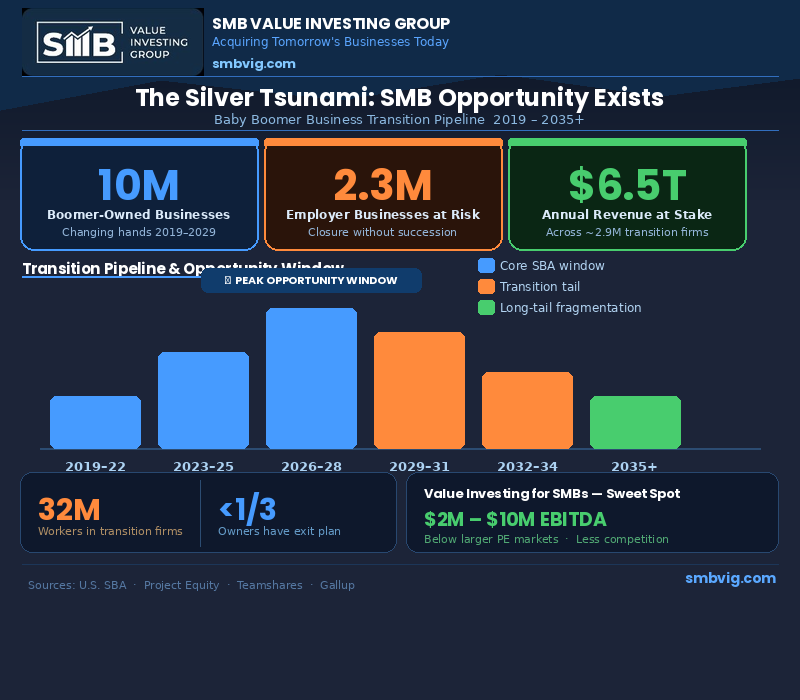
The core reason is simple: most owners are still not prepared. Teamshares has documented that fewer than one in three small business owners have an exit plan in place. Gallup’s research reinforces the same picture, particularly among non-employer business owners where succession planning gaps are most severe. When an owner does not plan their exit, they tend to sell in a motivated, off-market process not through a formal auction. That means less competition for the buyer and more room to negotiate fair pricing.
This is precisely the environment the accredited investor investment process at SMB Value Investing Group is designed for. We are not competing for auctioned assets at the top of the market. We are building relationships with owners who need a solution, not a bidding war.
How Long Will This Last?
The honest answer is longer than most people expect but the premium conditions will not last forever.
If you anchor on the SBA estimate, the core transition decade runs through 2029. In practice, though, transitions do not end on a calendar date. Many owners delay, attempt internal succession, or explore employee ownership before ultimately coming back to a sale process. Project Equity’s research on closure risk suggests the pressure continues well into the early 2030s because the underlying problem a retiring owner with no successor does not resolve itself without outside intervention.
At SMB Value Investing Group, our base case is a 10 to 15 year robust opportunity window, running roughly from the mid-2020s through the early-to-mid 2030s. The special conditions driving this window are demographic: a one-time cohort of business owners hitting retirement age simultaneously, most of them without a succession plan. That kind of demographic bulge does not repeat.
After the core Boomer wave passes, SMB M&A will remain active fragmentation, roll-up strategies, and generational transitions continue indefinitely. But the distinct pricing inefficiency created by a surplus of motivated sellers relative to prepared buyers is most pronounced right now, during the main transition period. The SMB opportunity exists today in a way it simply will not a decade from now.
What Makes This an Investable Thesis
The reason the small business acquisition opportunity for investors is so compelling is not just the volume of available deals it is the price at which those deals can be done.
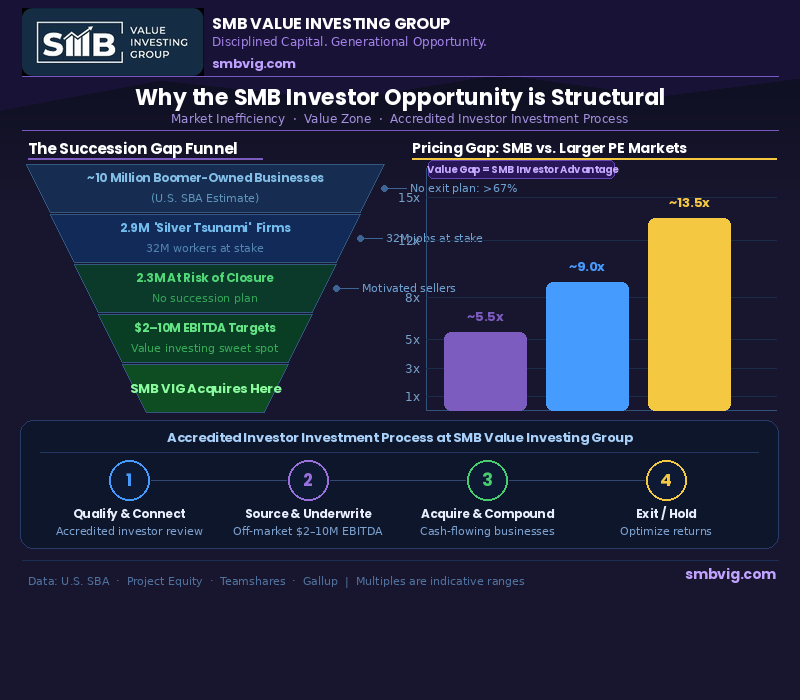
Businesses in the $2M to $10M EBITDA band typically transact at 4x to 6x earnings. Comparable businesses in the lower-middle market transact at 8x to 10x. Larger private equity targets routinely command 12x to 15x. That gap is not accidental — it reflects the relative sophistication of buyers at each tier. Most institutional capital cannot operate efficiently at the SMB scale. That leaves a large, profitable, and persistently underbought segment of the market available to disciplined buyers who have the right process and the right relationships.
For the accredited investor, the investment process does not require you to run the business yourself. It requires alignment with an operator-investor group like SMB Value Investing Group that sources off-market, underwrites conservatively, and acquires businesses built to generate consistent cash flow from day one.
The Bottom Line
The SMB opportunity exists because it is structural, not cyclical. Millions of owner-operated businesses are approaching a transition event. The majority of those owners have no plan. The result is a sustained, years-long supply of quality companies in the $2M to $10M EBITDA range—priced well below where larger markets clear, in deals that never reach a formal auction process.
This is not a one-year trade. It is a 10-plus year demographic-driven pipeline, and we are in the middle of the most concentrated part of it right now.
If you are an accredited investor exploring small business acquisition opportunities or simply want to understand how value investing for SMBs fits into a broader portfolio, SMB Value Investing Group is the place to start.