



If you have spent any meaningful time in private equity small business investments, you already know that the deal itself is rarely what makes or breaks your return. The asset matters, sure, but what matters far more is the person sitting in the operator’s seat. At SMB Value Investing Group, we have evaluated hundreds of opportunities over the years, and the single clearest pattern we keep seeing is this: Sponsor quality is the variable that explains the most variance in outcomes. Not the industry. Not the multiple paid. Not the leverage ratio. The sponsor.
This post walks through how we think about assessing independent sponsors when evaluating SMB deals, what we look for, what raises flags, and why getting this right is the foundation of a sound small business investment process.
Why the Sponsor Drives ~80% of the Outcome
This is not a figure we pulled from thin air. It is a pattern that shows up consistently across our own portfolio and the broader SMB market. When you are investing in businesses with lean management teams, limited institutional infrastructure, and high founder influence, the operator’s judgment becomes the operating system of the company. There is no large corporate bureaucracy to absorb bad decisions. There is no deep bench to compensate for weak leadership.
In this environment, a strong independent sponsor in the SMB market can compound value even from a mediocre starting point. A weak one can erode a genuinely good business. The math is unforgiving, which is why SMB Value Investing Group treats sponsor selection not as a screening step but as the core of our investment philosophy.
The Core Criteria We Use to Evaluate Sponsor Quality
Over time, we have distilled our evaluation down to a small number of high-signal criteria. We are deliberately not trying to score sponsors across fifty dimensions. The goal is to identify the variables that actually predict behavior under pressure.
Track Record Including the Difficult Chapters
The first thing we look at is not how many deals a sponsor has closed it is what they have actually owned and operated. Anyone can point to a win in a good market. What we want to understand is how they handled a business that went sideways. Did they recognize the problem early? Did they communicate it to investors or try to manage appearances? Did they make hard decisions about costs, personnel, or strategy, or did they delay until the situation became a crisis?
Sponsors with real operating scars tend to underwrite more conservatively and execute more effectively. That experience is not a liability; it is a qualification.
Industry Focus and Pattern Recognition
Specialization is underrated in SMB investing. When a sponsor has spent years in a specific sector whether that is field services, B2B distribution, specialty manufacturing, or healthcare, they develop an intuitive understanding of what drives customer retention, where margins leak, and which operational risks are structural versus fixable. That pattern recognition translates directly into faster sourcing, better underwriting, and more accurate post-close planning.
Generalists can succeed, but specialists have a real edge in the SMB VIG value creation playbook we have developed over the years.
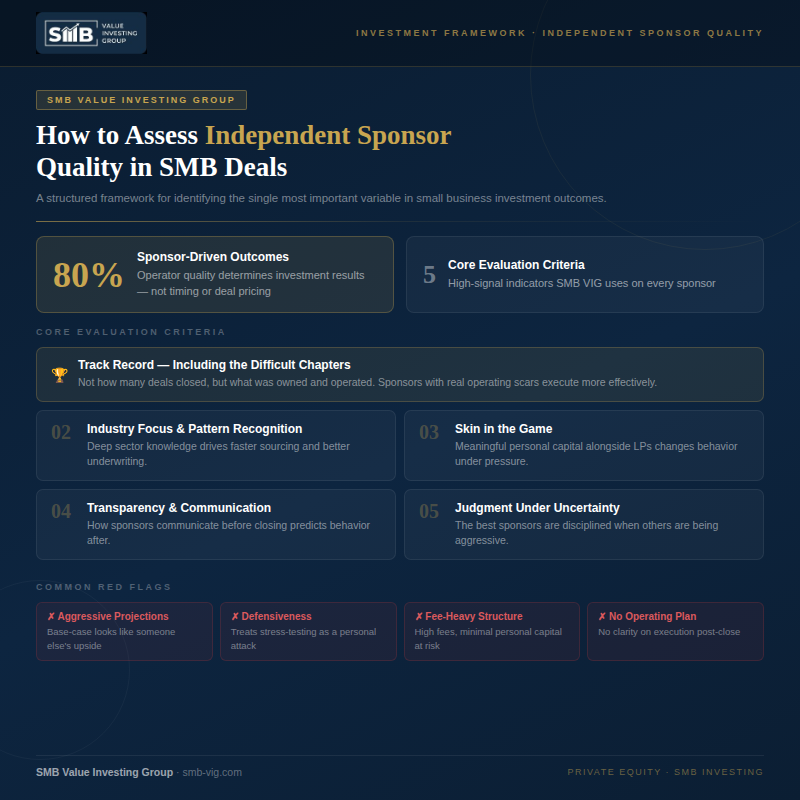
Skin in the Game
Capital alignment is not a philosophical concept it is a behavioral predictor. When a sponsor has meaningful personal capital at risk alongside LPs, they behave differently. Decisions get sharper. Downside scenarios get taken more seriously. Fee structures become less about income generation and more about protecting returns.
We pay close attention to sponsors who are willing to subordinate their own economics in order to protect investor capital. That willingness tells you a great deal about how they will behave eighteen months into a difficult operating environment.
Transparency and Communication Discipline
This one is simple but gets overlooked. How a sponsor communicates before closing is almost always how they communicate after closing. High-quality sponsors report clearly and consistently. They surface problems early rather than waiting until the situation is unavoidable. They frame risks honestly rather than burying them in footnotes.
Opacity is rarely accidental. When we encounter sponsors who are vague about risks, defensive about projections, or slow to provide requested information during diligence, we treat that as a meaningful signal, not a minor friction point.
Judgment Under Uncertainty
Any deal looks reasonable in a spreadsheet. Sponsor quality is what you discover when reality deviates from the model, and it almost always does. The questions we ask here are: How does this sponsor think about downside scenarios? Are they willing to walk away from a deal that no longer makes sense? Can they describe a clear decision-making framework, or do they default to optimism?
The best sponsors in the independent sponsors in the SMB market space are disciplined when others are being aggressive. That discipline is what separates durable value creation from cyclical luck.
Sponsor Evaluation Framework: Quick Reference
The table below summarizes the core criteria SMB Value Investing Group uses when assessing independent sponsors, along with the key questions and what strong versus weak indicators look like in practice.
| Criterion | Key Questions to Ask | Strong Signal | Red Flag |
| Track Record | What deals have they owned? Have they navigated a downturn? | Honest about failures; shares lessons learned | Only highlights wins; avoids discussing setbacks |
| Industry Focus | Can they explain customer economics and cost drivers in depth? | Deep sector knowledge; sourcing edge | Broad generalist with no clear focus area |
| Skin in the Game | How much personal capital are they investing? What are fee arrangements? | Meaningful co-invest; lean fee structure | Heavy fees; minimal personal capital at risk |
| Transparency | How do they handle bad news? What does their reporting look like? | Proactive; surfaces problems early with context | Vague reporting; defensiveness when challenged |
| Judgment | Can they walk you through a deal they passed on and why? | Disciplined; willing to walk away; thinks in downside scenarios | Aggressive assumptions; hubris; no clear walk-away criteria |
Red Flags Worth Taking Seriously
Even a strong resume can hide real weaknesses. In our experience evaluating independent sponsors in the SMB market, the most common warning signs are not always obvious on first impression. Overly aggressive projections are when base-case assumptions look like someone else’s upside case; that is telling you something about how the sponsor processes risk. Defensiveness when you push on assumptions is another. A good sponsor welcomes stress-testing. A poor one treats it as an attack.
Fee-heavy structures with limited co-investment are a structural misalignment, not just a negotiating point. And perhaps most telling: sponsors who cannot clearly articulate their post-close operating plan. A great acquisition thesis with no operational follow-through is not an investment it is a hope.
In SMB investing, hubris is one of the most expensive character flaws you can back.
How SMB Value Investing Group Approaches Sponsor Selection
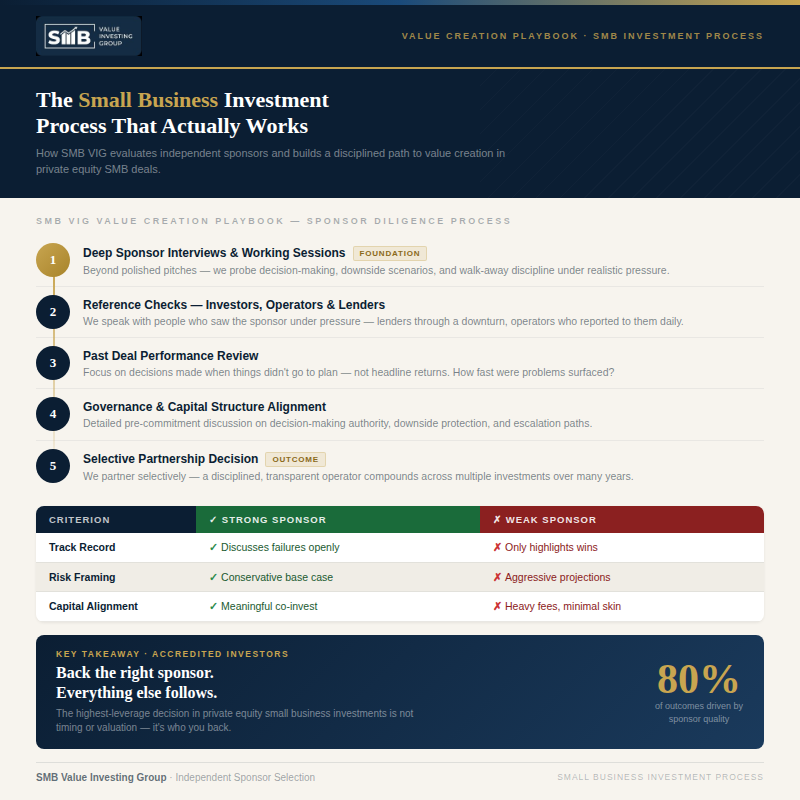
At SMB Value Investing Group, our diligence process on sponsors goes deeper than reviewing a track record document. We conduct deep working sessions not just polished pitch meetings where we are probing how sponsors think, not just what they have done. We talk to prior investors and lenders who have seen the sponsor under pressure. We review past deal performance with an emphasis on decisions made when things did not go to plan.
The SMB VIG value creation playbook also includes detailed governance and downside protection discussions before any capital is committed. We want to understand how decisions will get made, who has authority, and what the escalation path looks like when the business is off-track. This is not bureaucracy; it is how you protect investor capital in an asset class where lean management teams leave very little margin for error.
We partner selectively because sponsor quality compounds across multiple investments. A great relationship with a disciplined, transparent operator is an asset that pays dividends across many deals over many years.
The Highest-Leverage Decision in SMB Investing
For accredited investors exploring private equity small business investments, it is tempting to focus the most energy on deal pricing, leverage ratios, or market timing. Those variables matter but they are not where the game is won or lost. The highest-leverage decision you will make is choosing who to back.
A strong sponsor generates consistent alpha even from average businesses. A weak sponsor can destroy capital in a genuinely attractive asset. That asymmetry is what makes sponsor evaluation the cornerstone of a rigorous small business investment process and why it will always sit at the center of how SMB Value Investing Group allocates capital.
If you are building or refining your own process for evaluating independent sponsors, we are always open to a conversation. This is a discipline worth investing in.