



If you have ever sat across from an independent sponsor and found yourself nodding along while quietly wondering what half the terms actually mean, you are not alone. SMB investing has developed its own language, and fluency in that language is not just helpful. It is a practical form of risk management.
At SMB VIG, we believe that informed investors make better decisions, ask sharper questions, and ultimately build stronger partnerships with the operators and sponsors they back. This glossary covers the core terminology you will encounter in independent sponsor and self-funded searcher deals, organized by category so you can use it as a working reference, not just a one-time read.
Why Terminology Matters More Than You Think
SMB investing is relationship-driven and structurally nuanced. Unlike public market investing, where most terms are standardized and widely understood, private SMB deals involve negotiated structures, sponsor-specific economics, and deal-by-deal capital arrangements that can vary significantly from one transaction to the next.
A strong grasp of the vocabulary gives you the ability to evaluate whether investment criteria for small businesses are being applied rigorously, spot aggressive underwriting before it becomes your problem, and understand exactly how your capital is protected across different outcome scenarios. The SMB opportunity exists precisely because most capital has not figured out how to navigate this complexity efficiently. Those who invest the time to understand it properly are the ones who tend to see the best risk-adjusted outcomes.
Financial Performance: The Numbers That Actually Drive Returns
Every SMB deal begins and ends with financial performance. Understanding how profitability is measured, and where those measurements can be manipulated, is the foundation of sound due diligence.
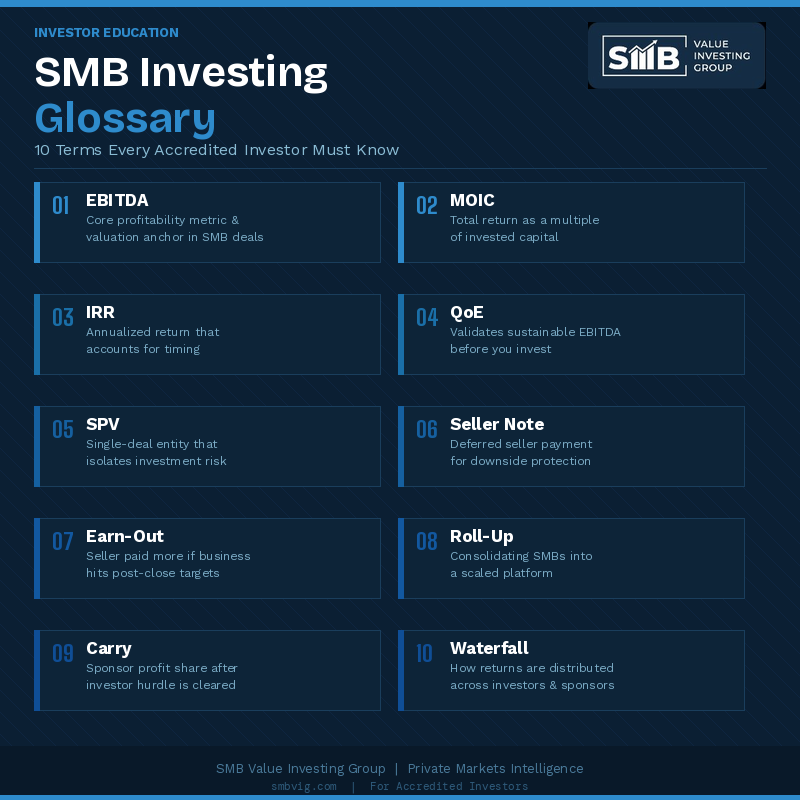
EBITDA (Earnings Before Interest, Taxes, Depreciation, and Amortization) is the most commonly cited profitability metric and the primary anchor for SMB valuations. Enterprise value in this market is almost always expressed as a multiple of EBITDA, which is why understanding the quality of that EBITDA number matters so much. Adjusted EBITDA takes the base figure and applies add-backs, meaning adjustments that attempt to normalize earnings by removing one-time or non-recurring costs. Some of those adjustments are completely legitimate. Others are aggressive, and separating the two requires a formal Quality of Earnings analysis for SMB investors, which we cover in more detail below.
Free Cash Flow is the metric that investors should arguably pay the most attention to. Distributions, debt service, and future investment all come from actual cash generated by the business, not from an EBITDA figure on a spreadsheet. A business showing strong EBITDA but consistently weak free cash flow is telling you something important about how much capital the business actually consumes to operate.
Valuation and Pricing: Where Deals Are Won or Lost
The entry multiple (how many times EBITDA you pay to acquire a business) is one of the single most important determinants of long-term investor returns. One of the core reasons the SMB opportunity exists is that businesses in this segment consistently trade at 3 to 6 times EBITDA, compared to 10 to 12 times for larger institutional targets. That pricing gap creates a structural advantage for disciplined investors who know where to look.
Multiple arbitrage is the strategy of buying at a lower multiple and selling at a higher one. In practice, this often happens when an operator builds a platform from several smaller acquisitions, professionalizes the business, and then exits to a financial or strategic buyer at a premium. The difference between a 4 times entry multiple and an 8 times exit multiple on the same earnings base is transformative for investor returns. Understanding how your sponsor plans to generate that multiple expansion is an important part of evaluating any deal.
Return Metrics: How to Read the Numbers
MOIC (Multiple on Invested Capital) and IRR (Internal Rate of Return) are the two primary lenses through which investors evaluate outcomes. MOIC is simple: divide total distributions by invested capital. A 3 times MOIC means you tripled your money. IRR is more nuanced because it accounts for timing, meaning a 3 times MOIC over 3 years produces a dramatically higher IRR than the same multiple over 8 years.
Neither metric is sufficient on its own. Sponsors can engineer impressive IRR figures through early distributions without generating meaningful total wealth. Conversely, a long hold period with a very high MOIC can look modest in IRR terms. The most reliable way to evaluate a deal is to understand both figures alongside the hold period assumption, which in SMB investing typically runs 4 to 7 years.
Key Terms at a Glance
The table below captures the most essential terms across deal structures, return metrics, and investor protections in a single reference view.
| Term | What It Means | Why It Matters to Investors |
| EBITDA | Earnings before interest, taxes, depreciation and amortization | The core valuation anchor in SMB acquisitions |
| MOIC | Multiple on Invested Capital (total return as a multiple) | Measures absolute wealth creation regardless of time |
| IRR | Internal Rate of Return (annualized, time-adjusted return) | Accounts for timing of cash flows and hold period |
| QoE | Quality of Earnings (independent EBITDA validation) | Prevents overpaying and catches aggressive add-backs |
| SPV | Special Purpose Vehicle (single-deal investment entity) | Isolates risk per deal; enables deal-by-deal investing |
| Seller Note | Deferred payment to seller (typically 10 to 30% of EV) | Built-in downside protection and seller alignment |
| Earn-Out | Additional seller proceeds tied to post-close performance | Bridges valuation gaps but must have clear measurable targets |
| Carry | Sponsor profit share after investor hurdle is cleared | Aligns sponsor incentives with LP returns |
| Roll-Up | Consolidating multiple SMBs into one scaled platform | Can drive multiple expansion but requires strong operators |
Quality of Earnings: The Most Important Due Diligence Step
Quality of Earnings analysis for SMB investors is the process by which an independent accounting firm validates the sustainability and accuracy of reported EBITDA. In plain terms, it answers the question of whether the earnings you are paying for are real, recurring, and representative of how the business will actually perform under new ownership.
A proper QoE will identify add-backs that are legitimate versus those that are inflated, analyze customer concentration and revenue durability, stress-test working capital assumptions, and flag any accounting treatments that may have made the business look more profitable than it truly is. At SMB Value Investing Group, we treat the QoE as a non-negotiable step in evaluating any acquisition, not a box-checking exercise. The investment criteria for small businesses must include rigorous earnings validation, because paying even a half-turn too much on an unsustainable EBITDA figure can meaningfully impair returns across the full hold period.
Roll-Up Acquisitions and Platform Strategy
Roll-up acquisitions in SMB investing represent one of the most powerful value creation strategies available to operators and sponsors. The concept is straightforward: acquire a platform business, then layer on smaller add-on acquisitions in adjacent markets or the same industry, building scale, operational leverage, and margin improvement along the way.
The appeal is significant. A business generating $2 million in EBITDA might exit at 5 times. The same earnings inside a platform generating $10 million could exit at 8 or 9 times, purely because of scale. That multiple expansion, combined with the organic earnings growth from add-ons, can produce exceptional investor returns. The risk, however, is very real. Integration complexity, operator bandwidth, and cultural mismatch across acquired businesses are common causes of roll-up underperformance. This is why backing the right operator is central to our investment thesis at SMB Value Investing Group. A roll-up in weak hands is far more dangerous than a straightforward single-company acquisition.
Capital Stack and Downside Protection
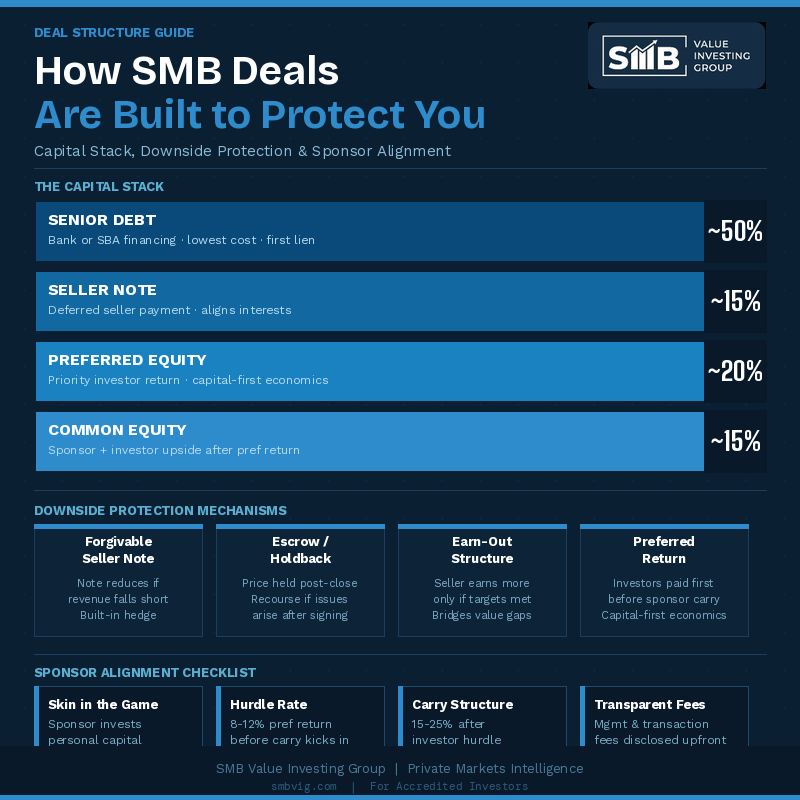
How a deal is structured financially determines how much risk you are actually taking as an investor, even when the underlying business performs in line with or slightly below expectations. The capital stack in a typical SMB acquisition includes a combination of senior debt, seller financing, and investor equity. Understanding where your capital sits within that stack, and what protections are in place, is fundamental to evaluating any deal.
The table below summarizes the most common structural tools used to protect investor capital in independent sponsor and self-funded searcher deals.
| Structure | How It Works | Investor Benefit |
| Seller Note | Seller accepts deferred payment instead of full cash at close | Reduces equity needed; seller stays accountable post-close |
| Forgivable Seller Note | Note is reduced if revenue or gross profit falls short | Mechanical downside protection built into deal structure |
| Preferred Equity | Investors receive priority returns and distributions | Capital-first economics in moderate or downside scenarios |
| Liquidation Preference | Investors recover capital before common equity or sponsor carry | Protects principal in scenarios short of a full exit |
| Escrow / Holdback | Portion of purchase price held pending post-close claims | Practical recourse if diligence issues surface after closing |
At SMB Value Investing Group, we prioritize deal structures that provide meaningful downside protection without sacrificing the operator’s ability to run the business effectively. A seller note that aligns the previous owner’s interests with new ownership is often worth more than an equivalent discount in purchase price, precisely because it keeps both parties rowing in the same direction.
Sponsor Economics: What You Should Always Ask
In independent sponsor and self-funded searcher deals, the economic relationship between the sponsor and the investor is defined by the waterfall, which describes how cash is distributed as the investment produces returns. Typically, investors receive their capital back first, then a preferred return (often 8 to 12 percent annually), followed by a catch-up provision for the sponsor, and then a split of remaining profits where the sponsor earns carried interest of 15 to 25 percent.
Understanding the hurdle rate, catch-up mechanics, and carry percentage is not a formality. Small differences in waterfall structure can materially shift economics between investors and sponsors in scenarios just above the hurdle. The most important indicator of alignment, however, is not the waterfall at all. It is whether the sponsor has meaningful personal capital in the deal. Skin in the game remains the single most reliable proxy for sponsor commitment and discipline.
A Final Word on Fluency
The terms in this glossary are not academic. They are the vocabulary of the deals you will actually evaluate, the structures that will protect or expose your capital, and the metrics by which your outcomes will be measured. At SMB Value Investing Group, we consistently find that investors who take the time to develop genuine fluency in this language become better partners to the operators we work with and make more confident, better-informed decisions at every stage of the investment process.
The SMB opportunity exists because this market rewards patience, rigor, and expertise. Knowing the language is where that expertise begins.