



Why Holding Period Risk Makes SMB Investment A Smarter Bet Than Venture Capital
When most investors think about risk, their minds jump to the obvious culprits: leverage, market downturns, or a business that simply fails. What rarely makes it onto that list, yet quietly erodes returns in countless portfolios, is time itself.
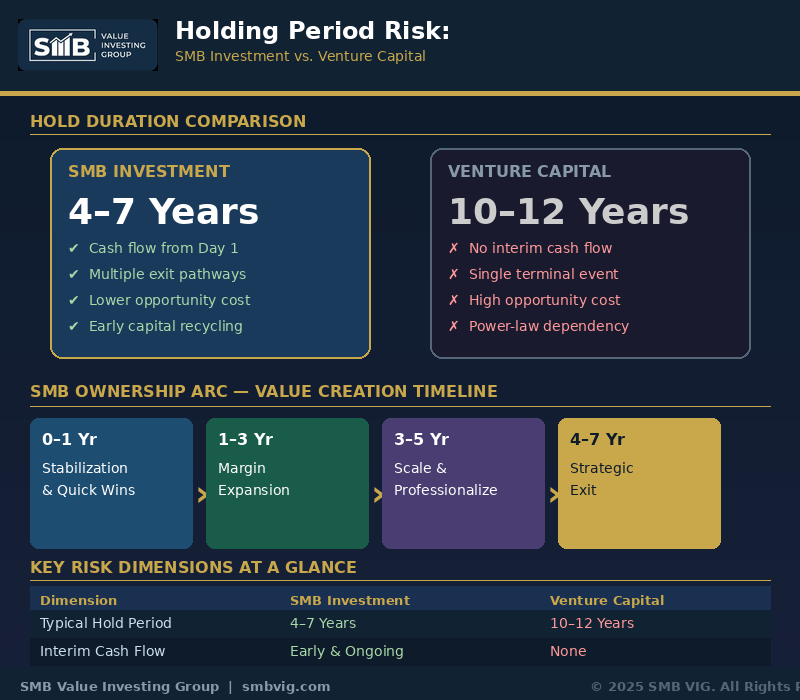
At SMB Value Investing Group, we’ve spent years studying how holding period risk shapes outcomes in private markets. And the conclusion is consistent: for investors who value capital efficiency, real cash flow, and intentional liquidity, the SMB investment model with its natural 4–7 year hold cycle offers a structurally superior risk-adjusted alternative to the 10–12 year commitments that define traditional venture capital.
What Holding Period Risk Actually Means
It’s tempting to think of a longer hold as simply “waiting longer.” But that framing undersells the compounding complexity that additional years introduce into any investment.
Holding period risk is the accumulation of uncertainty that builds as your capital stays committed. Interest rate environments shift. Competitive dynamics evolve. Technology that was once a moat becomes a liability. Management teams that were once hungry grow comfortable or exit entirely. And through all of it, your capital sits unavailable for redeployment into the opportunities that emerge in the meantime.
The key insight is that this risk does not grow linearly. Each additional year beyond your original thesis doesn’t add a flat increment of uncertainty it multiplies it, because each new variable interacts with all the ones that came before.
Why Venture Capital Requires a Decade-Plus Commitment
Venture capital isn’t structured for long holds by accident it’s structurally incapable of shorter ones. VC-backed companies typically start with no revenue, spend years searching for product-market fit, survive on external financing rounds, and depend on rare, difficult-to-time liquidity events like IPOs or strategic acquisitions.
The timeline below captures what that journey typically looks like:
| Years | Stage |
| 1–3 | Capital deployment phase |
| 3–6 | Burn cycles, pivots, follow-on funding rounds |
| 7–9 | A small number of portfolio winners begin to separate |
| 10–12 | Liquidity — if and when it arrives |
Until the very end of the fund’s life, most capital sits unrealized. There is no interim cash flow, no quarterly distribution check, and no mechanism for early exit. The entire value creation thesis is end-loaded into a single terminal event that may or may not materialize on schedule or at all.
How the Small Business Investment Process Works Differently
The small business investment process begins from a fundamentally different economic starting point. When SMB Value Investing Group evaluates a potential acquisition, the business already has customers, already generates cash, and already has identifiable operational improvement levers. We’re not betting on a future that might exist we’re improving a present that already does.
This changes everything about the risk profile. Value creation begins in month one, not year seven. Cash flows during the hold reduce the amount of invested capital actually at risk. And the exit isn’t a single binary moment it’s one of several viable pathways including strategic buyers, PE roll-ups, or management buyouts.
The ownership arc typically plays out like this:
| Period | Focus |
| 0–1 Yr | Stabilization, operational quick wins |
| 1–3 Yr | Margin expansion, process improvement |
| 3–5 Yr | Scaling, team professionalization |
| 4–7 Yr | Strategic exit or recapitalization |
A 4–7 year hold isn’t a rushed exit it’s a complete cycle of value creation, realized with full intentionality.
Time Amplifies What You Can’t Control
One of the most persistent misconceptions in private investing is that more time increases the probability of success. In reality, more time increases your exposure to variables you cannot control.
Over a 10–12 year horizon, the macro environment can complete an entire cycle from expansion to recession and back. Regulatory frameworks can be rewritten. The technology stack that underpinned your competitive thesis can become obsolete. Management teams can turn over multiple times. And through it all, investors remain locked in, hoping the outcome at the end justifies the uncertainty accumulated along the way.
The SMB investment model is explicitly designed to harvest value before these uncertainties have time to dominate outcomes. It doesn’t eliminate risk it compresses the window during which risks can accumulate.
Sponsor Incentives Reinforce Discipline
One reason SMB deals don’t drift indefinitely is the economic structure of how sponsors are compensated. Independent sponsors earn their returns through carried interest a share of realized gains not through long-dated management fees. This creates natural exit discipline that doesn’t exist in traditional fund structures.
When a deal performs well, the equity value compounds, carry builds up, and the opportunity cost of waiting grows material. When a deal underperforms, incremental time adds limited upside and the sponsor’s attention is better deployed elsewhere. Whether the outcome is great or mediocre, prolonging the hold is rarely the rational choice.
Opportunity Cost: The Risk Nobody Talks About
A 10–12 year capital lock-up carries an embedded assumption that most investors don’t consciously make: that no superior opportunity will emerge during that window, that portfolio strategy will remain static, and that liquidity will never be needed.
For almost every investor, that assumption is wrong.
Shorter hold periods a defining feature of the SMB investment process allow for earlier feedback, capital recycling, and portfolio rebalancing across market cycles. Even when headline IRRs look similar on paper, the capital efficiency of a 5-year cycle that completes and redeploys dramatically outperforms a 12-year cycle that ties up the same dollars.
Our SMB Investment Criteria: What We Look For
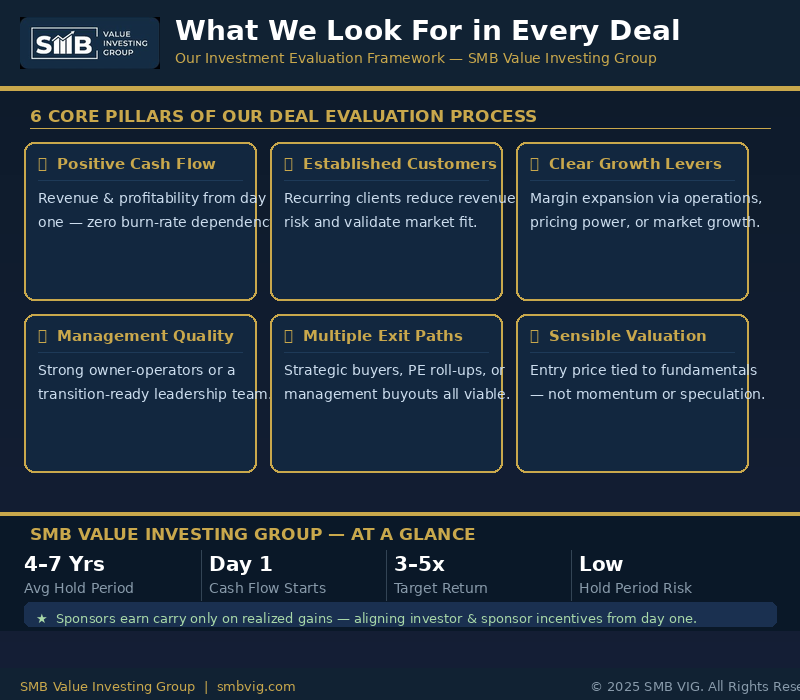
At SMB Value Investing Group, our SMB investment criteria are built around identifying businesses where value is tangible, achievable, and realizable within a disciplined timeframe. Every deal we evaluate is filtered through these fundamentals:
- Positive cash flow from day one — no burn-rate dependency
- An established, recurring customer base that validates market fit
- Clear operational improvement levers — margin expansion, pricing power, or process efficiency
- Strong owner-operators or transition-ready leadership
- Multiple viable exit pathways — not a single binary outcome
- Sensible entry valuation tied to fundamentals, not momentum
This is not a checklist to rush through. It’s the foundation of an SMB investment portfolio that can deliver consistent, risk-adjusted returns across different market environments.
Building a Resilient SMB Investment Portfolio
Vintage timing matters more than most investors acknowledge. Deals sourced in 2016–2017 benefited from exceptional exit conditions in 2020–2022, compressing hold periods naturally. Deals originated at the 2021 market peak have faced valuation resets and slower exit environments but the underlying businesses continued operating, generating cash flow, and building intrinsic value throughout.
This is the key distinction: in the SMB model, a delayed exit is inconvenient, not catastrophic. The business doesn’t stop working because exit conditions aren’t ideal. An SMB investment portfolio built on cash-flowing, fundamentals-driven businesses has a resilience that purely paper-value portfolios simply don’t.
The Risk-Adjusted Case in Summary
| Dimension | SMB Investment | Venture Capital |
| Typical Hold Period | 4–7 Years | 10–12 Years |
| Interim Cash Flow | Early & Ongoing | None |
| Liquidity Timing | Mid-cycle | End-loaded |
| Opportunity Cost | Lower | High |
| Outcome Dependence | Execution | Power-law winners |
The numbers tell a consistent story. Holding period length is not a neutral variable every additional year adds uncertainty, increases opportunity cost, and reduces flexibility.
Final Thoughts from SMB Value Investing Group
Venture capital has produced extraordinary returns for a small number of investors in a small number of funds over a handful of vintage years. We’re not dismissing it. But for investors who want capital efficiency, real cash flow, and predictable liquidity timelines the SMB investment model offers a structurally different, and in many environments, structurally superior path.
The small business investment process isn’t about finding the next unicorn. It’s about building an SMB investment portfolio grounded in disciplined SMB investment criteria, executing through a well-defined ownership arc, and realizing value before the world has time to change the thesis.At SMB Value Investing Group, that’s exactly what we do.