



Are Roll-Ups a Good Strategy for SMB Acquisitions?
Roll-up strategies have become one of the most discussed approaches in private SMB investments, and for good reason. When executed with discipline, they can meaningfully accelerate returns, build more durable platforms, and unlock exit multiples that a single business could never achieve on its own. But roll-ups are not a plug-and-play playbook. They are an execution strategy, and the difference between a well-structured roll-up and a costly misadventure almost always comes down to operator capability and underwriting discipline.
At SMB Value Investing Group, we have spent considerable time studying how consolidation strategies perform across fragmented SMB sectors. This post distills what we’ve learned-covering why roll-ups work, where they break down, and the framework we apply when evaluating opportunities.
Why Fragmented Markets Are Ideal for Roll-Ups
The foundation of any successful roll-up is a fragmented market. Many SMB sectors, particularly in B2B services, niche manufacturing, and specialty distribution, remain dominated by founder-owned businesses that have never been institutionally organized. These businesses often run on informal systems, underdeveloped pricing strategies, and owner-dependent relationships.
That fragmentation creates two distinct advantages for a disciplined acquirer. First, deal flow is abundant. There are many sellers, limited institutional competition at smaller deal sizes, and a meaningful cohort of owners approaching retirement without a natural succession plan. Second, there is real room for professionalization, which is a fancy way of saying that basic operational improvements can unlock margin expansion quickly.
This is a core part of the small business investment process: identifying sectors where the opportunity to consolidate is clear, the targets are accessible, and the synergy case is grounded in operational reality rather than financial engineering.
How Multiple Arbitrage Actually Works
One of the most compelling aspects of roll-up investing is what the industry calls multiple arbitrage the valuation gap between small, standalone businesses and scaled platforms.
Smaller businesses typically trade at 3–5× EBITDA because of key-person risk, customer concentration, and limited institutional reporting. Once you assemble a platform with diversified revenue, clean financials, and professional management, institutional buyers will pay 7–9× EBITDA for that same underlying cash flow.
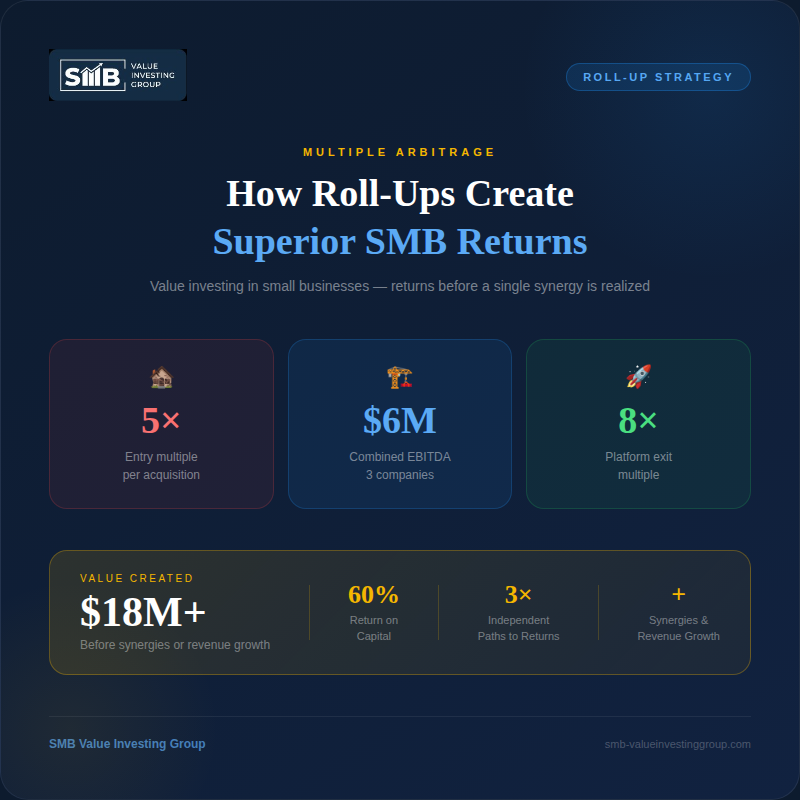
Here is a simplified illustration of how that math works in practice:
| Scenario | Entry (5x EBITDA) | Exit (8x EBITDA) |
| 3 companies at $2M EBITDA each | $10M per company / $30M total EV | $48M combined exit value |
| Combined EBITDA | $6M | $48M |
| Value Created | — | $18M+ (before synergies) |
This value creation happens before accounting for margin improvement, revenue growth, or operational synergies-which means a well-underwritten roll-up has multiple independent paths to returns.
Where Roll-Ups Break Down: The 7 Failure Modes
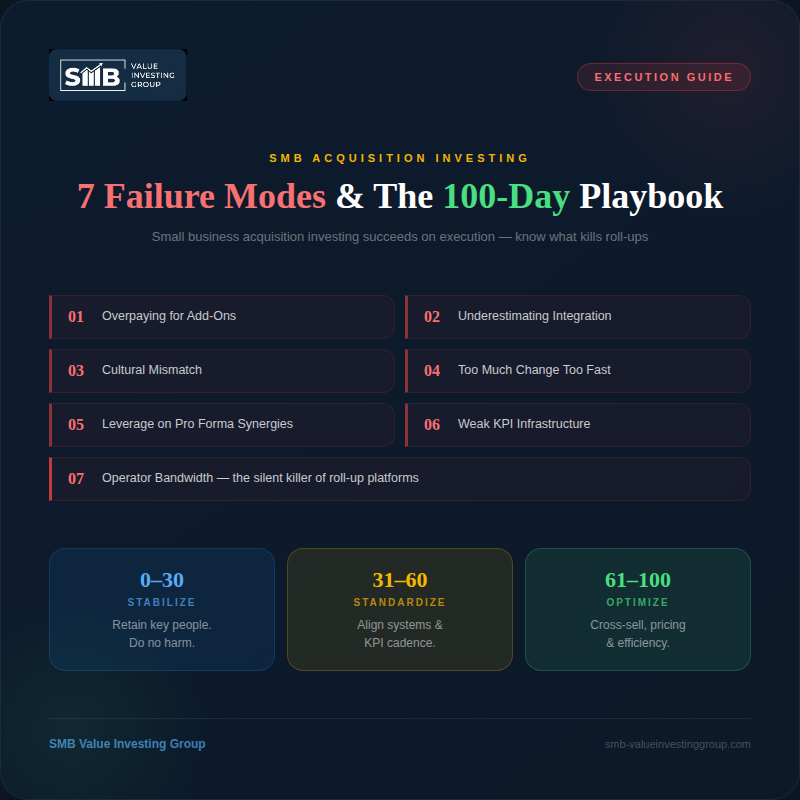
The strategy itself is rarely the problem. What kills roll-ups is execution. Based on what we’ve observed across private market investing processes, the same failure patterns emerge repeatedly.
| Failure Mode | What Goes Wrong |
| Overpaying for Add-Ons | Competitive deal processes erode the multiple arbitrage advantage. Paying 6–7× for add-ons defeats the math. |
| Underestimating Integration | Billing breaks, key managers leave, customers churn. Systems don’t just ‘eventually align.’ |
| Cultural Mismatch | A professional platform culture clashing with an informal, relationship-driven target can destabilize both. |
| Too Much Change Too Fast | Stacking new pricing, new systems, new leadership, and new branding simultaneously overwhelms the business. |
| Leverage on Pro Forma Synergies | Debt sized against synergies that haven’t been realized yet creates fragility when things don’t go to plan. |
| Weak KPI Infrastructure | If reporting is poor, problems surface late — often too late to intervene cost-effectively. |
| Operator Bandwidth | Each integration consumes leadership time. Without bench strength, quality deteriorates across the platform. |
The SMB Value Investing Group Underwriting Framework
At SMB Value Investing Group, we apply a consistent set of filters before recommending roll-up activity within a portfolio. This is core to our small business acquisition investing philosophy: the platform must be ready before add-ons begin.
Platform Readiness
Before any add-on acquisition, the platform company should have clean monthly financials, a functioning KPI cadence, a stable leadership team, and proven unit economics. If the platform itself is unstable, every add-on becomes a distraction rather than an accelerant. This is non-negotiable in our SMB deal investment steps process.
Target Profile Fit
The best add-ons share a similar customer type and buying motion, compatible service delivery models, and retainable management. Operational adjacency whether that means shared scheduling, routing density, or procurement leverage is a meaningful signal that synergies will be real and capturable.
Conservative Integration Economics
We only model synergies that are contractual and visible: vendor renegotiations, back-office consolidation, and insurance savings. Cross-sell assumptions are kept conservative. The deal must work even if synergies take longer than expected to materialize or don’t fully arrive. This conservative posture is what separates disciplined private market investing from speculative roll-up plays.
Pacing Over Ambition
Most failed roll-ups move too quickly. Our recommended pace for most operators looks like this: focus on platform stability in year one, prove integration repeatability with one or two add-ons in year two, and scale to two or three add-ons annually only after bench strength has been built. Patience here is a feature, not a limitation.
A Practical 100-Day Integration Playbook
Regardless of deal size, the first 100 days after closing are the highest-risk period for any acquisition. Here is the framework SMB Value Investing Group recommends operators follow:
| Phase | Priority Actions |
| Days 0–30: Stabilize | Issue retention bonuses for key managers. Send customer continuity messaging. Ensure payroll and billing run without disruption. The guiding principle is “do no harm.” |
| Days 31–60: Standardize | Align chart of accounts. Establish KPI reporting cadence. Begin obvious vendor consolidations and procurement renegotiations. |
| Days 61–100: Optimize | Align pricing policies. Launch cross-sell initiatives. Implement sales enablement and lead routing. Begin operational efficiency programs. |
What Investors Should Ask Before Backing a Roll-Up
From an LP or co-investor perspective, the private market investing process for evaluating roll-up deals should always address the following questions. Is the platform strong enough to absorb complexity? Does the operator have a repeatable integration playbook, or is each acquisition treated as a one-off? Are add-ons being sourced proprietarily, or are they coming from competitive auction processes that compress returns? Does the model still work if synergies never materialize? Is leverage sized against actual earnings, not pro forma projections? And is there meaningful bench strength beyond the CEO to run integrations in parallel?
If those questions can be answered confidently, roll-ups can represent a genuine edge in value investing in small businesses not just a narrative.
SMB Value Investing Group Takeaway
Roll-ups are one of the most powerful value creation tools available in small business acquisition investing combining operational synergies, revenue quality improvement, and multiple arbitrage into a single strategy. But the returns belong to operators who build on stable platforms, price acquisitions with discipline, and integrate with a repeatable playbook. At SMB Value Investing Group, we view execution rigor not acquisition ambition as the true differentiator.