



Why Independent Sponsors Are Quietly Outperforming Traditional Private Equity in SMBs
A structural shift has been unfolding in the lower middle market for the better part of a decade and most investors in public markets have barely noticed it. Independent sponsors, once viewed as a niche corner of the private equity world, have emerged as one of the most effective ownership models for small and medium-sized business acquisitions. The numbers are starting to reflect what practitioners already know from the ground up.
The Quiet Rise of Independent Sponsors
According to the McGuireWoods 2024 Independent Sponsor Survey, deal activity in this space has grown roughly 2.5 times since 2016. That is not a blip. Institutional LP participation has expanded meaningfully alongside that growth, and the model is now firmly embedded in the lower-middle-market ecosystem.
What is driving this? The short answer is structural alignment. Independent sponsors operate on a deal-by-deal basis, raising capital for specific opportunities rather than managing blind pools with deployment deadlines. In a market like SMB acquisitions where each business carries its own operational profile, founder dynamics, and execution risk that kind of flexibility is not a minor convenience. It is a meaningful competitive advantage.
At SMB Value Investing Group, we partner regularly with independent sponsors precisely because their model fits how good SMB investing actually works. It rewards sourcing relationships, patient underwriting, and hands-on value creation not the ability to move large amounts of capital quickly.
Four Structural Advantages That Are Hard to Replicate
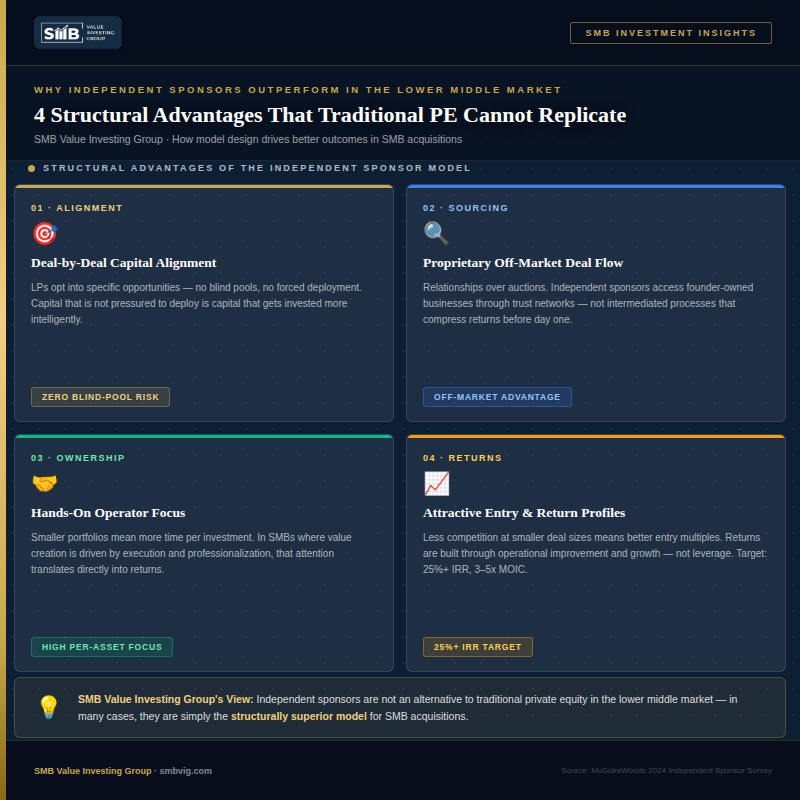
The outperformance of independent sponsors in SMBs is not accidental. It follows directly from four structural features of the model that traditional private equity funds simply cannot replicate at scale.
The first is capital alignment. When capital is not forced to deploy when an LP can opt into a specific deal rather than committing to a blind pool, it tends to be deployed more intelligently. Independent sponsors carry no pressure to put money to work by a certain date. That sounds like a small thing until you consider how many PE fund deals happen not because they are the best opportunities available, but because the clock is running.
The second advantage is flexibility in complex transactions. SMB acquisitions often involve founder succession, seller rollovers, earn-out structures, SBA financing, and non-standard diligence timelines. Independent sponsors are built for exactly these situations. They negotiate directly, structure creatively, and pursue proprietary or off-market deals that never reach a formal auction process. For owner-operators selling businesses they have spent decades building, that kind of relational, patient approach matters far more than the polished pitch decks that larger PE funds bring to the table.
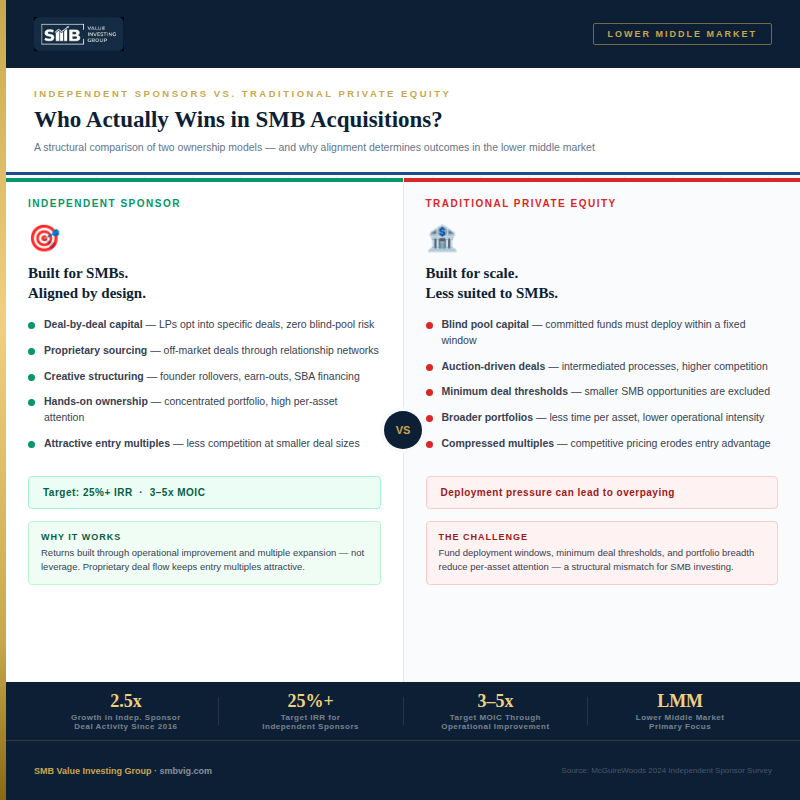
Third, independent sponsors run smaller, more concentrated portfolios. They spend more time per investment and work closely with management teams after close. In SMBs, where value creation is driven by execution, leadership development, and operational professionalization, that hands-on presence often translates into better outcomes than a highly diversified fund model ever could.
Fourth, the return targets are ambitious but realistic. Independent sponsors typically pursue 25%+ IRRs and 3–5x MOIC, achieved through genuine operational improvement and multiple expansion rather than leverage alone. Because they focus on smaller, less competitive deal sizes, entry multiples tend to be more attractive than what traditional PE funds face in the mid-market.
Independent Sponsor vs. Traditional PE Fund: At a Glance
To understand why this model outperforms in the lower middle market, it helps to put the two structures side by side. The differences are not subtle.
| Factor | Independent Sponsor | Traditional PE Fund |
| Capital Structure | Deal-by-deal, LP opt-in | Blind pool, committed capital |
| Deployment Pressure | None – selective by nature | Time-bound fund cycles |
| Deal Sourcing | Proprietary, off-market focus | Intermediated auctions |
| Transaction Flexibility | High – creative structuring | Lower – standardized process |
| Portfolio Depth per Asset | High – concentrated focus | Lower – broader portfolio |
| Entry Multiples | Attractive (less competition) | Compressed (competitive) |
| Target Returns | 25%+ IRR, 3-5x MOIC | Varies by fund mandate |
| LP Visibility | Full transparency per deal | Limited until reporting |
What This Means If You Are an LP
From an investor’s perspective, the independent sponsor model solves for something that traditional fund investing rarely addresses cleanly: the ability to know exactly what you own. There is no blind-pool risk. There is full visibility into each asset before capital is committed. Portfolio construction is flexible rather than dictated by a fund mandate.
As a result, sophisticated accredited investors, family offices, and repeat institutional LPs have been increasingly drawn to this model — not as an alternative corner of the market, but as a deliberate choice. The private market investing process that works here is one built around transparency, specific asset evaluation, and co-investment alignment. That is a very different experience from committing to a fund and waiting for quarterly reports.
There is also a deal-size advantage worth naming directly. Independent sponsors consistently access opportunities that are simply too small for traditional PE funds to pursue. Those deals are not lower quality; they are often structurally better businesses with less competition, better entry pricing, and more room to add value through basic professionalization and growth initiatives.
Where Traditional PE Is Structurally Disadvantaged
None of this is a criticism of private equity as an asset class. Traditional PE funds do extraordinary work in the right contexts. The issue is fit. A fund with billions under management has real constraints in the SMB segment: minimum deal size thresholds that exclude smaller opportunities, pressure to deploy large pools of capital within a defined window, portfolio breadth that limits per-asset attention, and governance structures that can feel misaligned to small business owners who have never worked with institutional capital before.
Those constraints can quietly lead to overpaying at entry, applying excess leverage to make returns work, or under-resourcing portfolio companies after close. None of those outcomes are intentional, but they are predictable consequences of the model operating outside its natural habitat.
How SMB Value Investing Group Thinks About This
At SMB Value Investing Group, independent sponsors are not simply deal sources they are investment partners whose model we have deliberately built around. Our SMB investment criteria is designed to work in concert with the way the best independent sponsors operate: proprietary sourcing, patient underwriting, creative structuring, and long-term ownership orientation.
The sponsors we work with share a few consistent traits. They think like business owners, not financial engineers. They have sourced deals through relationships rather than banker processes. They understand the specific operational levers that drive value in smaller businesses. And they are genuinely invested in outcomes not just at close, but through the full hold period.
If you are curious about how the independent sponsor vs self-funded search debate plays out in practice and how those two models differ in terms of capital alignment, operational involvement, and return profiles we explore that distinction in detail across our research. Visit smbvig.com to dig into how we evaluate these models and where we see the most compelling opportunities in today’s market.
Key Takeaways
Independent sponsors have grown their share of lower-middle-market deal activity by 2.5x since 2016 because the model is structurally better suited to SMB investing not because the market got lucky. Deal-by-deal capital alignment, proprietary sourcing, hands-on ownership, and attractive entry multiples are not features of a niche strategy. They are the foundations of durable value creation in this segment.
In a market where execution matters more than financial engineering and alignment determines outcomes, independent sponsors are not an alternative to traditional private equity. In many cases, they are simply the better model.