



At SMB Value Investing Group, we work with accredited investors who are navigating the accredited investor investment process for the first time. One of the most important things we do is help them separate perception from evidence. This blog works through the five most persistent myths in the SMB investment space, backed by real data and grounded in how deals actually get done.
At a Glance The 5 Myths vs. Reality
| Myth | What People Think | What the Data Shows |
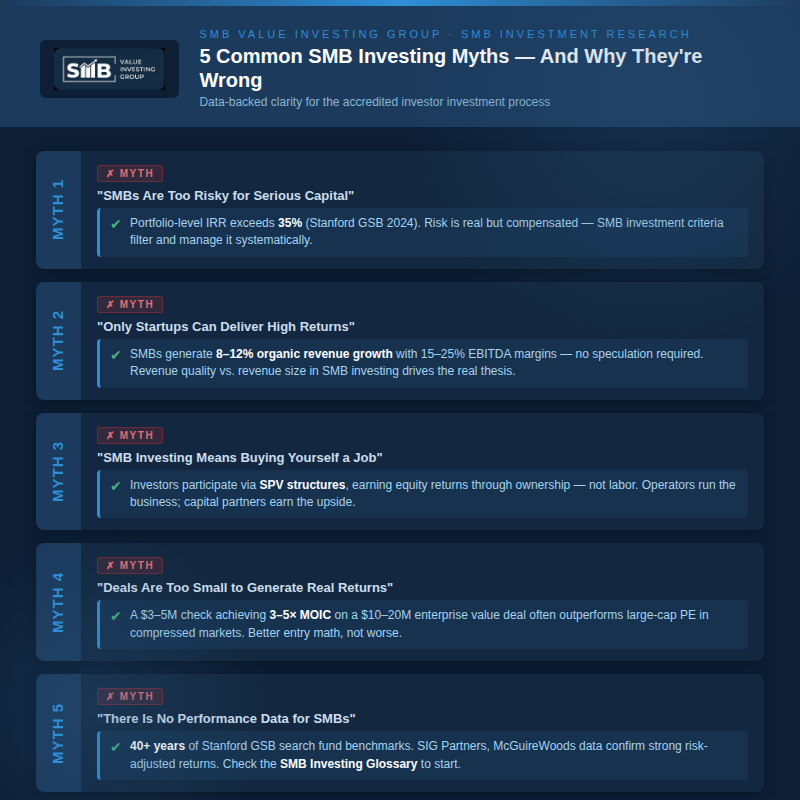
| SMBs Are Too Risky | Small businesses are fragile and prone to failure | 35%+ aggregate IRR (Stanford GSB 2024) — risk is compensated |
| Only Startups Grow | High returns need venture-style innovation | 8–12% organic growth, 15–25% EBITDA margins, cash flow from day one |
| It’s Buying a Job | Investors must operate the business full-time | SPV structures give equity returns — operators run the business |
| Deals Are Too Small | SMB check sizes are immaterial to serious investors | 3–5× MOIC on a $3–5M check often outperforms large-cap PE |
| No Performance Data Exists | Private SMB markets lack benchmarks or transparency | 40+ years of Stanford GSB search fund data, SIG Partners, McGuireWoods |
Myth 1: 2014 SMBs Are Too Risky
This is perhaps the most widespread misconception. The instinct to equate ‘small’ with ‘fragile’ is natural but it conflates individual deal outcomes with portfolio-level performance, and those are two very different things.
The Stanford Graduate School of Business Search Fund Study (2024) found that while roughly 31% of search fund deals lose money, aggregate returns exceed 35% IRR. That asymmetry where strong performers materially outweigh losers is exactly how institutional private equity operates. Risk exists, but in a properly constructed SMB investment, that risk is compensated, measurable, and manageable through sound SMB investment criteria.
The accredited investor investment process at SMB Value Investing Group is built around this reality. We do not pretend every deal is a home run. We build portfolios designed to capture the upside while managing the inevitable variance.
Myth 2: 2014 Only Startups Offer High Growth
Venture capital has dominated the cultural conversation around investing for two decades. But the mental model it creates exponential curves, winner-take-all markets, zero-to-one disruption does not describe how most wealth is actually built.
Well-run SMBs routinely generate 8–12% organic revenue growth with 15–25% EBITDA margins, positive cash flow from day one, and established customer relationships that do not require speculative product-market fit. This is a different kind of growth quieter, steadier, and far more repeatable.
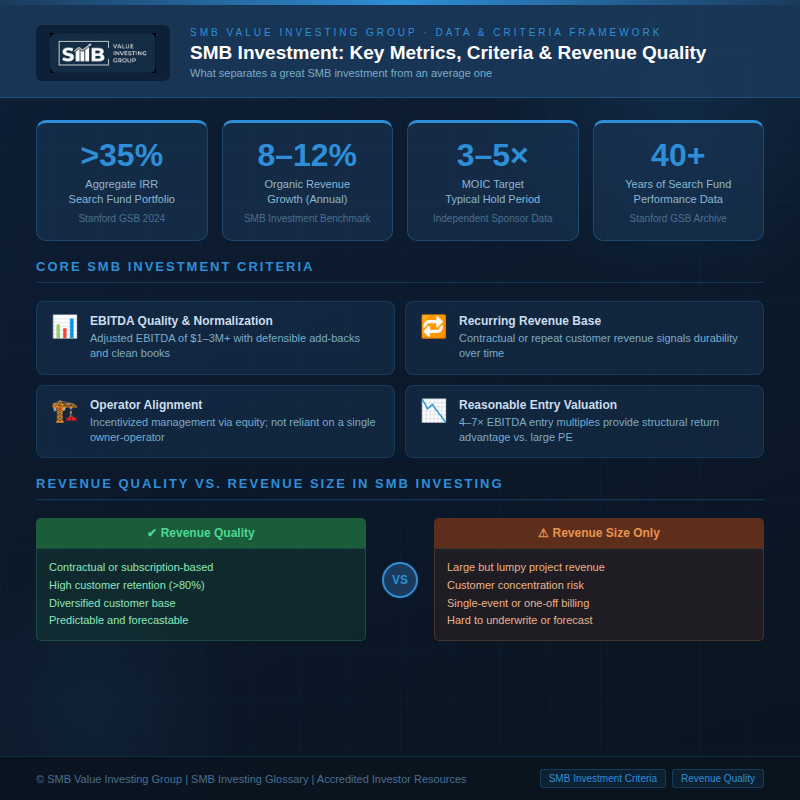
This is also where understanding revenue quality vs. revenue size in SMB investing becomes critical. A business with $4M in highly recurring, contractual revenue is a fundamentally different investment than one with $8M in lumpy, one-off project work. SMB Value Investing Group evaluates this distinction as a core part of our underwriting process.
Growth in SMBs compounds it just does not announce itself on a pitch deck.
Myth 3: 2014 It’s Just Buying Yourself a Job
This myth gets repeated often and it confuses two very different roles: operators and investors.
In modern SMB transactions, independent sponsors and self-funded searchers typically install or retain professional management, align those managers with equity incentives, and structure investor participation through SPVs. Capital partners at SMB Value Investing Group earn equity returns, not wages. The management team runs the business; investors benefit through ownership.
If you are evaluating an SMB investment opportunity as part of your accredited investor investment process, the relevant question is not ‘will I be running this company? ‘Is the operator qualified, incentivized, and aligned with my interests?’ That is precisely what rigorous SMB investment criteria are designed to evaluate.
Myth 4: 2014 Deals Are Too Small to Matter
Institutional investors who think in terms of $100M+ checks sometimes dismiss SMB deals as immaterial. But return magnitude matters more than deal size, and the math in smaller transactions is often more attractive, not less.
Consider a $3–5M equity check into a business with $10–20M enterprise value. If that business achieves a 3–5× multiple on invested capital (MOIC) over a typical hold period, the absolute dollar return and IRR can easily outperform what large PE funds are achieving in today’s compressed, high-multiple market.
Smaller deals often offer better entry valuations, more operational leverage, and cleaner exit dynamics. The inefficiency in the SMB investment space is not a flaw it is the source of alpha.
Myth 5: 2014 There Is No Performance Data
This one is simply false and it tends to reflect unfamiliarity with the space rather than actual evidence of its absence.
The Stanford GSB Search Fund Study has tracked search fund performance for more than 40 years. SIG Partners publishes analysis of self-funded searcher outcomes. McGuireWoods runs ongoing surveys of independent sponsor deal activity and returns. These are rigorous, longitudinal datasets that consistently show attractive risk-adjusted performance when disciplined underwriting and strong operators are involved.
For investors building familiarity with the space, SMB Value Investing Group has compiled a practical SMB Investing Glossary covering key terms, structures, and metrics — from EBITDA normalization to seller financing to hold period assumptions. Understanding the vocabulary is step one of any serious accredited investor investment process.
SMB Investment Performance Key Data Points
| Performance Metric | Typical SMB Investment Benchmark |
| Aggregate IRR (Search Fund Portfolio) | > 35% — Stanford GSB Study, 2024 |
| Organic Revenue Growth | 8 – 12% annually |
| EBITDA Margins | 15 – 25% |
| Typical Equity Check | $3M – $5M into $10M – $20M EV businesses |
| MOIC Target | 3 – 5× over typical hold period |
| Deals Resulting in a Loss | ~31% individually — offset materially by strong performers |
Why These Myths Persist And Why That Creates Opportunity
SMB investment remains misunderstood for a few structural reasons. Deals are relationship-driven rather than indexable. Outcomes depend heavily on operator quality and execution. The space is not easily accessible to large institutions, which means it does not receive the same research coverage as public markets or venture capital.
But this is precisely the insight that drives SMB Value Investing Group’s model: the inefficiency that sustains these myths is also what creates alpha for disciplined investors who know how to evaluate SMB investment criteria properly. Less competition means better entry prices. Lower visibility means less capital chasing the same opportunities.
Inefficiency is not a flaw in the SMB investment space. It is the foundation of the return thesis
The SMB Value Investing Group Perspective
We believe SMB investment works not as a speculative bet, but as a foundational private markets strategy for four interconnected reasons.
Entry valuations in SMBs are structurally lower than in institutional PE markets. These businesses generate real, recurring cash flow from operations, which means you are not waiting on a liquidity event to validate the thesis. Value creation is operational and tangible: pricing discipline, management improvements, and add-on acquisitions. And exit markets for well-run SMBs are deep, with strategic buyers, private equity roll-up platforms, and other searchers all competing for quality assets.
When you layer in proper deal structure, aligned incentives, protective covenants, and downside provisions, you have a framework that many institutional asset classes struggle to replicate.
SMBs are not an alternative asset class. They are a foundational one that remains significantly underallocated in most accredited investor portfolios.
SMB Investing Glossary Terms Every Investor Should Know
Before entering the SMB investment glossary, every accredited investor should be fluent in the following terms. These form the foundation of the accredited investor investment process and directly impact how deals are evaluated, structured, and exited.
Investor Takeaway
At SMB Value Investing Group, our role is to provide that partnership, disciplined process, transparent structure, and decades of combined operating and investing experience across the SMB investment landscape.
If you are beginning your accredited investor investment process or looking to deepen your understanding of SMB investment in practice, we would welcome the conversation.
Reach out to SMB Value Investing Group to learn more about the accredited investor investment process and how our SMB investment criteria framework works in practice.