



How SMB Investment Returns Compare to Private Equity, VC, and Public Markets
Most investors have heard of venture capital and private equity. Far fewer have seriously looked at small business investment and that gap is exactly where the opportunity lives.
At SMB Value Investing Group, we have spent years studying the lower-middle market, and the data keeps pointing to the same conclusion: SMB investment consistently delivers some of the strongest risk-adjusted returns in private markets, often without the leverage dependency or binary outcomes that make other strategies so unpredictable.
This is not a niche thesis. It is a structural one.
What the Long-Term Data Actually Shows
The cleanest dataset for evaluating professionally executed SMB investment comes from search funds independently sponsored acquisition vehicles that have operated long enough to produce four decades of auditable outcomes.
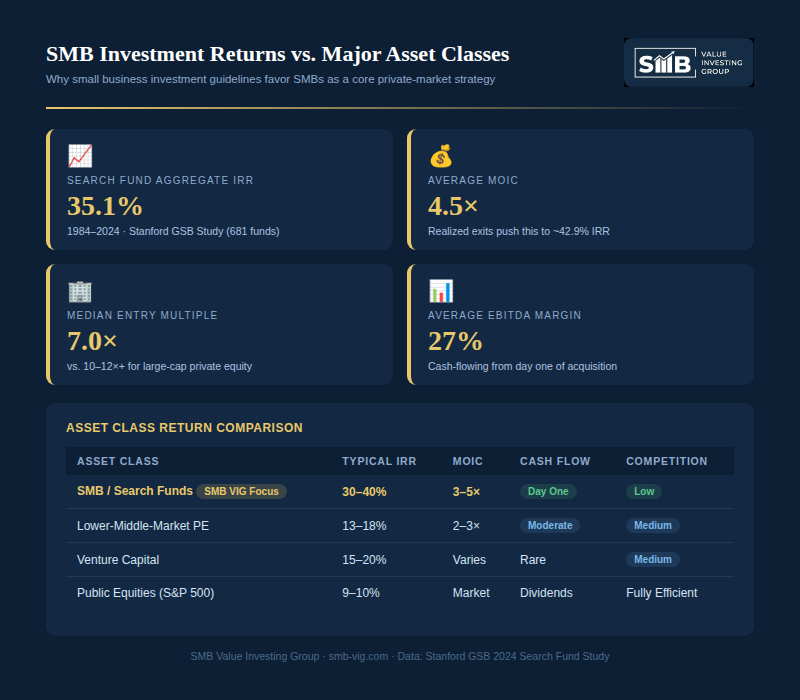
According to the Stanford Graduate School of Business 2024 Search Fund Study, which analyzed 681 funds from 1984 through 2024, the aggregate IRR across all search fund activity sits at approximately 35.1%, with an average MOIC of 4.5×. When you isolate only realized exits the deals that made it all the way through to liquidity the IRR climbs to 42.9%.
That is not a rounding error. That is structural alpha.
SMB Investment vs. Other Asset Classes
To understand why these numbers matter, it helps to see them side by side:
| Asset Class | Typical IRR | MOIC | Cash Flow Profile | Market Efficiency |
| SMB / Search Funds | 30 – 40% | 3 – 5× | Day-one positive EBITDA | Highly inefficient |
| Lower-Middle-Market PE | 13 – 18% | 2 – 3× | Moderate | Moderately competitive |
| Venture Capital (pooled) | 15 – 20% | Varies widely | Rare before exit | Highly competitive |
| Public Equities (S&P 500) | 9 – 10% | Market rate | Dividends | Fully efficient |
The pattern is clear. SMB investment occupies a genuinely differentiated position: returns that rival or exceed venture capital, but backed by real operating cash flow from the moment of acquisition rather than speculative future growth.
Why the Return Distribution Looks Different Here
One of the most important things to understand about SMB investment is the shape of its return distribution. Unlike venture capital, where a handful of unicorn outcomes must compensate for widespread failure, SMB deals tend to produce meaningful returns across a broader range of outcomes.
Among realized SMB acquisitions, roughly 36% land in the 2–5× MOIC range solid, repeatable, professional-grade returns. Another 25% reach 5–10×. About 11% exceed 10×. Losses do occur, affecting roughly 31% of deals in some form, but the severity is typically limited by the fact that these businesses were generating positive EBITDA from day one. Cash flow provides a floor that pure equity bets simply do not have.
This is one of the core reasons SMB Value Investing Group structures every deal around operating income quality rather than projected growth multiples. The cash flow is not a bonus it is the foundation.
The Structural Reasons SMBs Outperform
None of this performance is accidental. There are four structural factors that consistently explain why disciplined SMB investment generates returns that larger, more institutionalized strategies struggle to replicate.
Entry pricing remains favorable. SMBs typically trade at 3–6× EBITDA. Comparable assets at the large-cap PE level routinely command 10–12× or more. Lower entry prices create a built-in margin of safety that no amount of operational improvement can manufacture after the fact. The 2024 data shows the median acquisition sitting at approximately $14.4 million enterprise value with a 7.0× entry multiple still well below what larger funds compete for.
Value creation comes from operations, not leverage. Returns in this segment are driven by professionalization, pricing discipline, cost management, and strategic add-on acquisitions not financial engineering. This is a meaningful distinction. When interest rates move, operationally driven businesses are far less exposed than those built on debt structures.
The market remains structurally inefficient. Most SMBs are founder-owned, succession-constrained, and too small to attract investment banking coverage. Large funds cannot deploy meaningfully at these deal sizes. Individual buyers often lack the operational expertise or capital to close. This creates a persistent information and execution gap that benefits disciplined buyers who follow sound small business investment guidelines.
Cash flow is real and immediate. This point is worth repeating because it fundamentally changes the risk profile. Unlike venture-backed businesses that may be years from profitability, an acquired SMB typically distributes cash during the hold period. That ongoing income reduces the probability of total capital loss and gives investors optionality that illiquid, pre-revenue assets simply cannot offer.
The SMB VIG Investment Process
At SMB Value Investing Group, the SMB VIG investment process follows a disciplined five-stage framework designed to identify, acquire, and grow lower-middle-market businesses with durable cash flows and clear exit paths.
It begins with proprietary deal sourcing targeting founder-owned businesses in non-competitive channels before they reach marketed processes. From there, rigorous underwriting focuses on cash flow quality, margin sustainability, and customer concentration risk. Structuring prioritizes conservative capital with downside protections built into deal terms. During the hold period, the focus shifts to operational improvement: pricing discipline, talent upgrades, and selective add-on acquisitions that extend the platform’s reach. The process concludes with a defined exit strategy whether a PE sale, strategic acquisition, or recapitalization established before capital is committed.
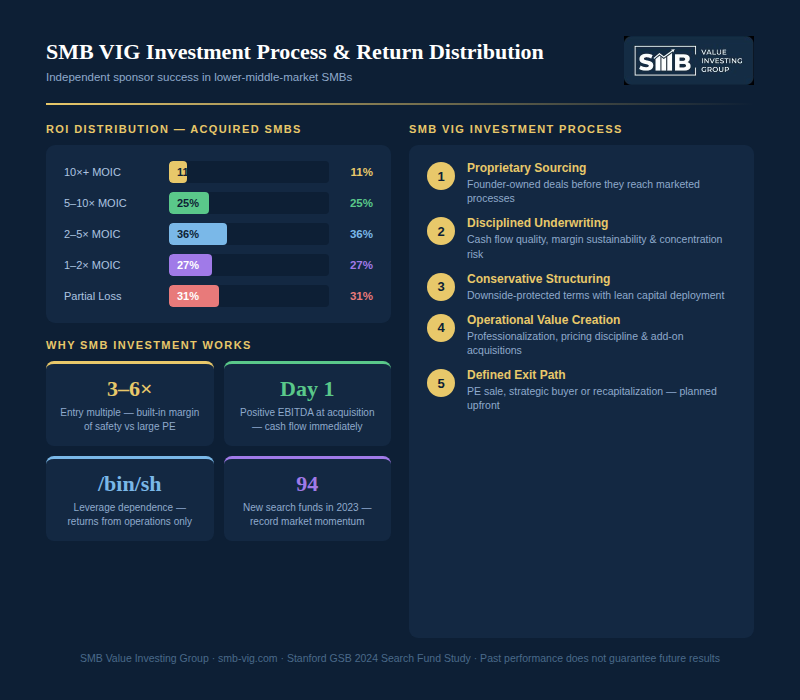
This is what independent sponsor success in lower-middle-market SMBs actually looks like in practice: not opportunistic, not reactive, but methodical.
The Competitive Landscape Is Changing But the Opportunity Persists
More capital is paying attention to this segment. 2023 saw a record 94 new search funds launched globally. Acquisition activity dipped modestly a sign of discipline, not declining opportunity. Average EBITDA margins across acquired businesses remained strong at approximately 27%, with average growth of 25%.
The gating factor has never been the supply of quality businesses. The gating factor has always been execution: the ability to underwrite correctly, operate effectively, and exit strategically. Increased interest in the space does not eliminate the opportunity it raises the bar for who captures it.
What This Means for Investors
If you are allocating to private markets and your portfolio skews heavily toward venture capital or large-cap buyout funds, there is a meaningful case for examining what a lower-middle-market SMB allocation could do for your risk-adjusted return profile.
SMB investment offers genuine alpha not the theoretical kind derived from optimistic projections, but the kind backed by forty years of realized outcomes, real operating cash flows, and businesses that have already proven their market position before a dollar of acquisition capital is deployed.
At SMB Value Investing Group, we treat this not as an alternative allocation but as a core private-market strategy. One that is underrepresented in most institutional and family office portfolios, and one that continues to reward disciplined operators and investors who understand where structural inefficiency persists.